

Sustainable sanitation, circular approaches and a focus on re-use of wastewater and faecal sludge are game changers to many of the challenges countries and the economy faces around water: Ending pollution from human waste benefits human and environmental health and leads to economic opportunities through improved water quality. Climate resilient sanitation leads to better resilience of society under climate stress. Reuse is a solution to address water scarcity, providing safe water to people, industry and ecosystems. Closing nutrient cycles and providing renewable energy sources helps to respect planetary boundaries.
To bring those messages into global fora, SuSanA has been actively involved in the process towards the UN 2026 Water Conference and discussions on stakeholder engagement and has contributed to formal stakeholder consultations since early 2025.
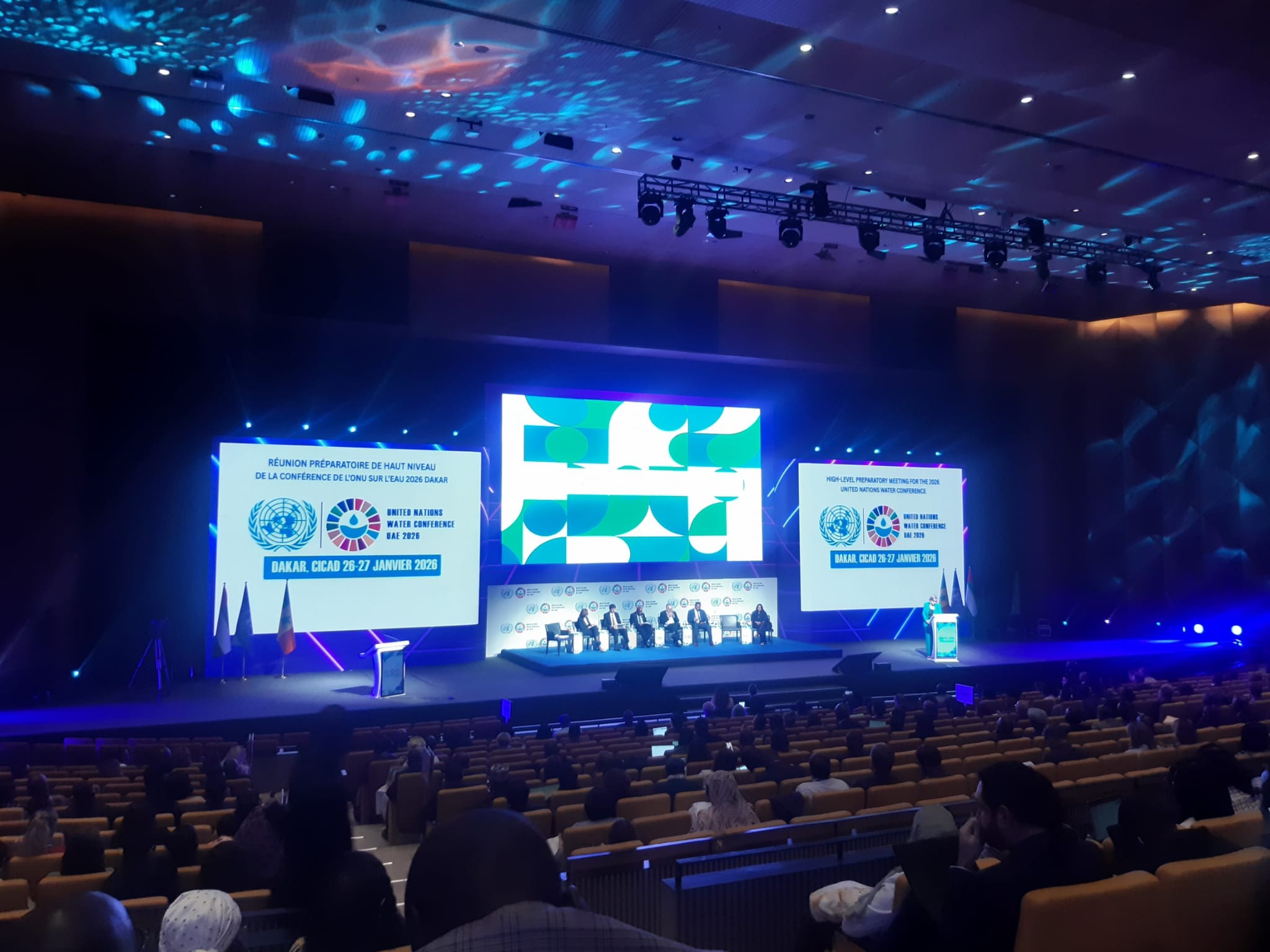
In late January, Senegal and the UAE, together with the United Nations, hosted the Dakar High-Level Preparatory Meeting. Preceding it, a dedicated One-Day Stakeholder Meeting convened by UN DESA - in collaboration with Senegal and the UAE and in partnership with the German WASH Network and SuSanA’s partner ANEW, supported by the German Federal Ministry for Economic Cooperation and Development (BMZ) - brought together civil society, Indigenous peoples, women’s and youth groups, persons with disabilities, academia, the private sector and other actors (Video, Report). The aim was clear: voice pressing challenges, exchange practical approaches for cooperation at multiple levels, and shape concrete proposals to accelerate universal access to water and sanitation. The outcome was a set of six initial 2-page think pieces and six key statements to UN Member States, aligned with the conference’s six interactive dialogues:
- Water for People,
- Water for Prosperity,
- Water for Planet,
- Water for Cooperation,
- Water in Multilateral Processes,
- Investments for Water.
While sustainable sanitation cuts across all six dialogues, SuSanA has taken a special interest in Interactive Dialogue 2 - Water for Prosperity, due to its focus on wastewater re-use and circularity. Following a call for applications by UN DESA, SuSanA was selected as lead facilitator, co-lead by Indigenous Science/ Women in Water Diplomacy Network.
With only a few days until Dakar, SuSanA and Indigenous Science/ Women in Water Diplomacy Network started online consultations and an intense multi-stakeholder process: organizing a virtual working group, hosting a webinar, consolidating diverse stakeholder inputs into a 2-page think piece and a statement with key messages. SuSanA and Indigenous Science/Women in Water Diplomacy also prepared to facilitate the in-person session in Dakar to gather more input and consolidate the key statement to report back to the main High-Level Preparatory Meeting 26th – 27th January.
Having safely arrived in wonderful Dakar and the One-Day Stakeholder Meeting on 25th January, the facilitation team hosted a focused, one-hour working group that provided additional input to the discussion, kick-started exchange on potential partnerships and synergies, and finalized the statement with key messages for Interactive Dialogue 2.
Disa Crow Chief (SikSika Nation, Blackfoot Youth Water Council) delivered the group’s statement both in the plenary of the One-Day Stakeholder Meeting and at the UN High-Level Preparatory Meeting. Find the final documents here: 2-page think piece, statement
The multi-stakeholder contributions inform the UN member state -led Interactive Dialogues that will provide key content for the UN Water Conference in December.
The key messages to the co-hosts of the Conference and the co-chairs of Interactive Dialogue 2 are:
- Adopt a Human Rights- based Approach and fully implement existing tools and mechanisms of good water governance.
- Expand “Water for prosperity” to a more comprehensive set of indicators of prosperity to capture diverse values and meanings of water, also towards a post2030 Framework.
- Address the capacity and the gender gap in water and wastewater jobs
- Shift the wastewater narratives and foster solutions for people and planet, like circular sanitation approaches and nature-based solutions.
- Recognize and advance Indigenous knowledge, Indigenous science and Indigenous earth observations.
For meaningful participation we urgently call on the co-hosts and co-chairs to:
- Provide enough time for people to organize engagement.
- Provide access and resources to coordinate and participate.
- Provide a robust participation mechanism for all Interactive Dialogues and the conference now.
- Integrate Indigenous knowledge, Youth perspectives, and Women’s voices in the main program, not side events.
- We are confident that the stakeholder process we have seen in Dakar has proven to be a good foundation for the upcoming months, the UN Water Conference 2026 and beyond.
The Dakar meetings have been only the start of a busy year for everyone engaged in international processes on water and sanitation. Stakeholders jointly provided a shared foundation for priority areas in the Interactive Dialogues in the lead-up to the 2026 UN Water Conference. SuSanA and partners will continue to actively engage in the process and connect stakeholders, keeping the focus on actionable pathways that bring sustainable sanitation for all within reach.
Interested in joining our efforts? Engage via SuSanA and our partner networks!
