

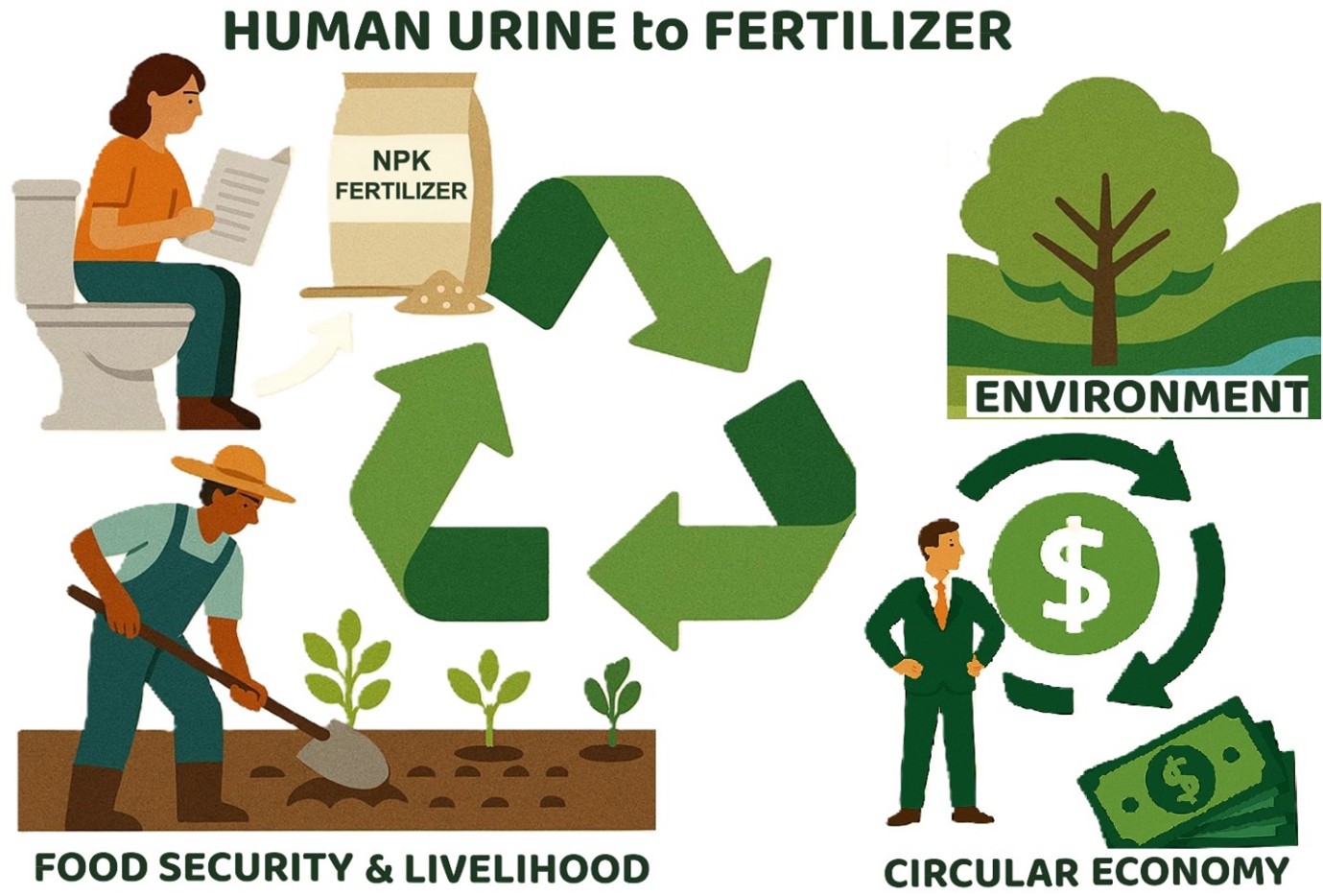
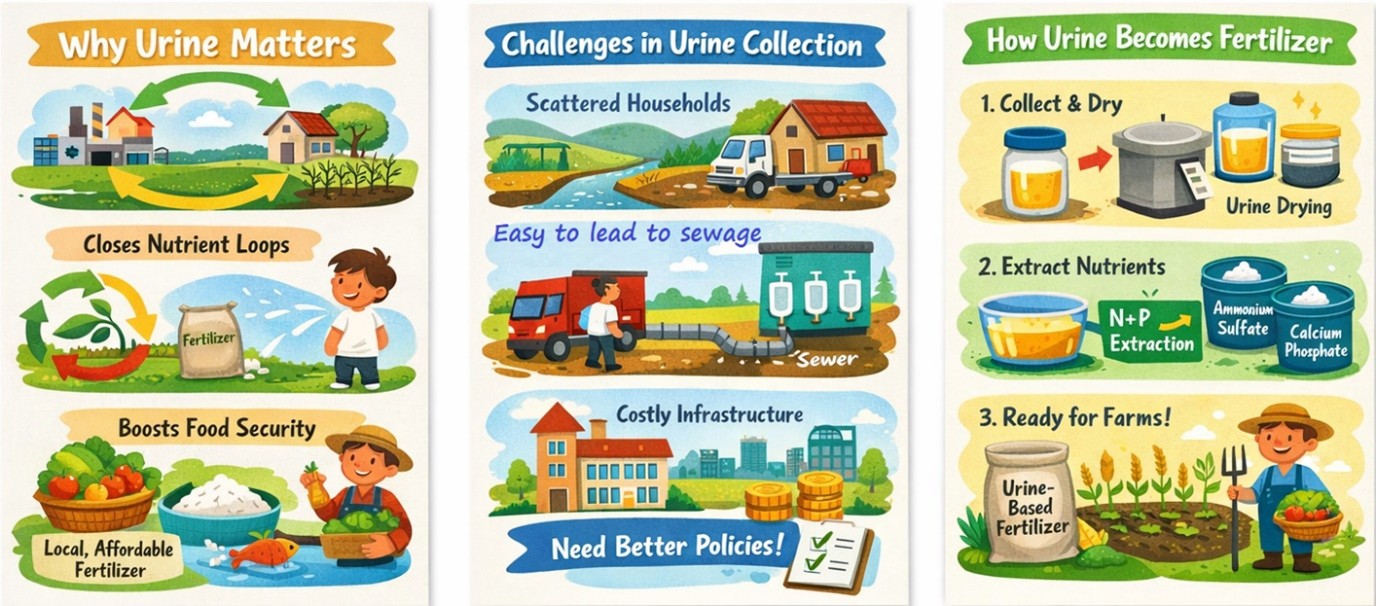
Figure is generated with AI
Why Urine Matters for Food Security and Sanitation
Recycling nutrients from urine isn’t just about waste management but it benefits society in three keyways:
1. It closes nutrient loops
Instead of relying entirely on synthetic fertilizers derived from fossil fuels and mined minerals, urine recycling creates a circular nutrient economy. This reduces dependence on non-renewable resources and mitigates the environmental damage caused by mining and fertilizer production.
2. It improves sanitation and reduces pollution
Separating urine from fecal waste reduces nutrient loads in wastewater, easing pressure on treatment plants, and preventing nitrogen and phosphorus pollution in waterways.
3. It strengthens food security
In many regions, such as Sub-Saharan Africa, fertilizers are expensive and often scarce. The availability and pricing of mineral fertilizers are highly volatile due to geopolitical tensions, as seen in conflicts involving Russia-Ukraine and the US-Israel-Iran. Farmers typically use less than a quarter of the amount of fertilizer used in Europe and America, leading to lower crop yields and higher food prices.
Urine-based mineral fertilizers offer a locally produced and affordable alternative that can boost crop production and support local economies. This approach directly contributes to SDG6 (Clean Water and Sanitation) and SDG2 (Zero Hunger).
So why isn’t urine-derived fertilizer already a global norm?
Communities, researchers, and entrepreneurs are working on practical ways to turn human urine into safe, market-ready fertilizer products. But despite its potential, the urine-to-fertilizer sector still faces several barriers that must be addressed before it can grow into a sustainable business.
The Bottleneck: Collecting Urine at Scale
The biggest challenge to creating a sustainable urine-to-fertilizer industry is collecting large volumes of urine reliably and affordably.
- Household urine-diverting toilets exist, but scaling is tricky
Urine-diverting dry toilets (UDDTs) and other source-separating toilets work well in rural areas and off‑grid settings. However, collecting urine from scattered households quickly becomes expensive and logistically challenging.
- Public Urinals: A missed opportunity?
Men’s public urinals already separate urine, but most of it still flows into sewer networks instead of dedicated collection tanks. Installing new infrastructure or retrofitting conventional toilets with urine diversion modules would require significant investment, making large-scale collection difficult.
The solution? Policy incentives could motivate urine collection
Cities could likely accelerate urine reuse by offering subsidies for:
- Installation of urine-diverting toilets in apartment buildings
- Urine collection tanks
- Regular urine emptying services
Without a supportive policy, infrastructure, and maintenance costs remain a major barrier.
How can urine be transformed into fertilizers?
Several promising technologies already exist to convert urine into safe, market-ready fertilizer products, each with strengths and limitations.
1. Direct Use of Urine
This is a simple and low-cost way of recycling urine as fertilizer. Urine can be collected, stored, and applied directly as fertilizer in small community fields or home gardens. But this method is not practical for a large-scale because transporting large volumes of liquid urine is costly.
2. Urine Drying and Concentration
Urine can be dried and concentrated to reduce the volume and create a more compact fertilizer. But drying a large volume of urine often requires a large amount of energy, which can make the process expensive.
3. Struvite Production
Phosphorus and nitrogen can be precipitated and recovered as struvite. This process recovers mostly phosphorus but a very small amount of nitrogen.
4. Nutrient Extraction to Produce Mineral Fertilizers (most promising for business)
Using techniques like aeration and membrane filtration, nutrients in urine can be turned into ammonium sulfate and calcium phosphate, fertilizers that are chemically identical to conventional products sold in stores.
Because these products look and behave like standard fertilizer, they can enter the existing agricultural supply chain. This also helps ease public concerns about using recycled urine, as the final products no longer resemble the original material.
What is still missing?
Most urine-to-fertilizer technologies are still at lab or pilot scale. To reach commercialization, we need:
- Simple, low-tech systems for small and medium enterprises.
- Semi‑continuous or fully automated systems.
- Pilot plants ready to be tested under real operating conditions.
Is Urine-to-Fertilizer Economically Viable?
In many cases: yes. While transportation is the major cost driver, the economics can be surprisingly strong when processing facilities are located close to collection points, and technology is efficient.
For example:
- 10,000 liters of urine contain about $40 worth of nitrogen fertilizer.
- Using a mineral fertilizer-producing technique, a plant could earn over $14,000 per year from this amount of urine.
- This could support 2–5 workers, creating local jobs while improving sanitation.
Integrating urine recycling with other waste-recovery businesses (e.g., composting) can make the model even stronger.
What Will It Take to Move Forward?
A thriving urine-to-fertilizer sector will require more than just technology. It needs collaboration, investment, and bold policy choices.
- NGOs & humanitarian organizations
These groups already invest heavily in WASH programs, yet rarely in nutrient recovery. Piloting urine‑to‑fertilizer systems in their WASH program in refugee camps, schools, and dense settlements could demonstrate their feasibility.
- Entrepreneurs
With the right incentives, local businesses can adopt scalable, profitable models, either as standalone fertilizer producers or integrated with other waste‑recycling services.
- Researchers & technology developers
Partnerships are essential to test their technology in a real-life environment. This will help to understand its feasibility, process optimization, user experience, and market potential.
- Governments
Supportive regulations and subsidies can turn urine collection and recycling into a national asset for both sanitation and agriculture.
A Future Where Fertilizer Comes From Cities, Not Mines
Turning urine into fertilizer is more than an ecological sanitation trend, it’s a circular economy solution connecting urban sanitation, rural agriculture, and climate resilience.
If we invest now in smart technologies, supportive policies, and community-centered models, urine‑derived fertilizers could become a cornerstone of sustainable agriculture and sanitation worldwide.
For further information, take a look here: SuSanA Library - Sustainable Sanitation Alliance - SuSanA
