

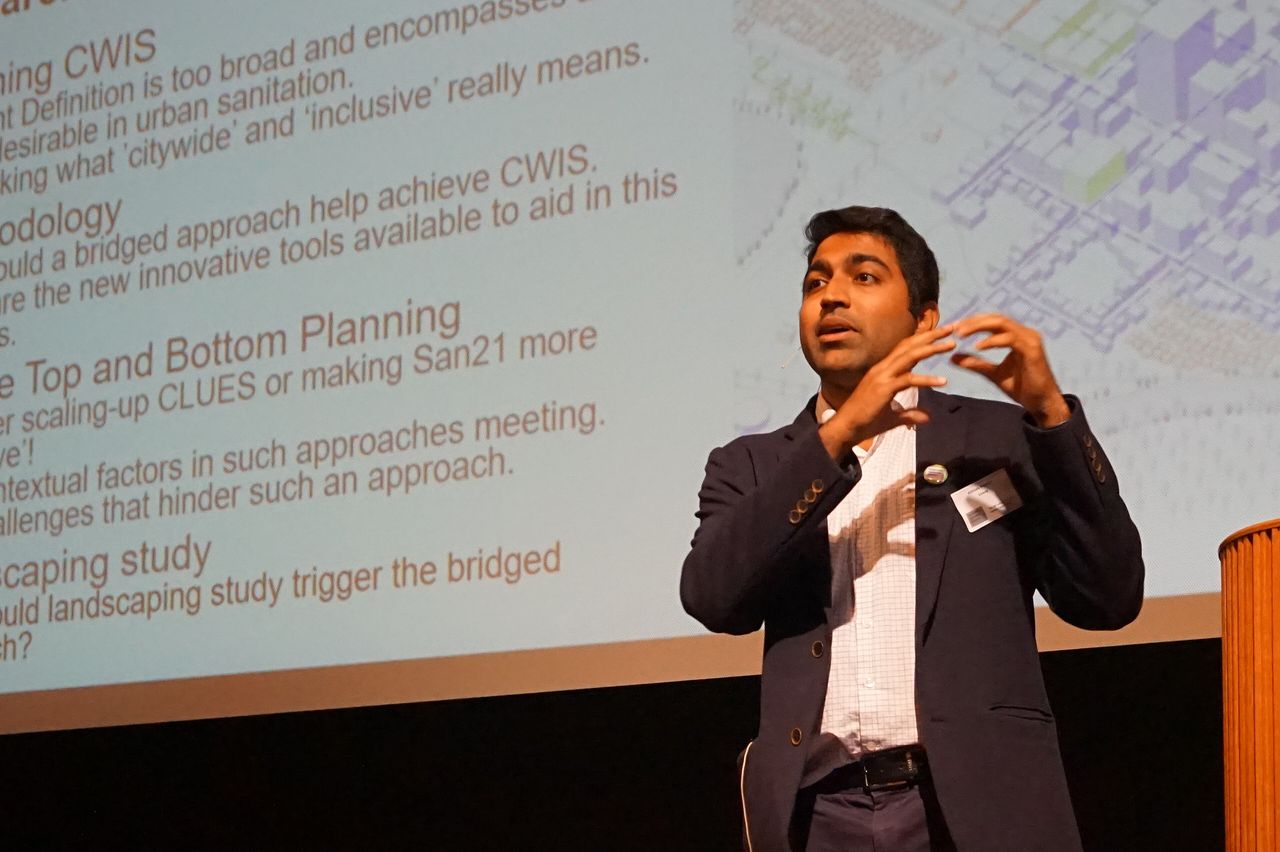
In Abishek’s case, the award recognises two distinct but connected strands of work:
- Bridging science and policy: research and practice in sustainable sanitation, Citywide Inclusive Sanitation (CWIS), wastewater treatment and reuse, and integrated basic services, with impact across South Asia, Sub-Saharan Africa and beyond
- Empowering young professionals: creating platforms for youth leadership through the Swiss Water Partnership Youth and the Global Youth Movement for Water
For Abishek, it is the combination of the two that gives the award its significance.
“This is a meaningful award to me since it recognises the efforts that go beyond where research typically stops: bridging science and policy. It also puts a spotlight on the impactful work that a generation of young people are doing in the water sector, from the grassroots to the multilateral levels.”
From a polluted river to sanitation
Abishek’s path into sanitation began on the water. Growing up in a megacity in India, he rowed on rivers where the pollution was impossible to ignore. He wanted those rivers cleaned up, and in tracing the problem back to its sources he found sewer connections and wastewater treatment plants that were not working. That led him to a conclusion that has shaped his career ever since: urban water problems cannot be solved without addressing sanitation.
“If you want to solve water problems, you need to solve sanitation problems, because they’re two sides of the same coin.”
That conviction carried him from chemical engineering to environmental engineering, and from there into public and environmental policy. Today, he works as a Scientist at Eawag-Sandec and is a visiting lecturer at several universities. Within SuSanA, he co-leads the Cities working group and sits on the advisory board, while also advocating for youth empowerment in water, sanitation and hygiene (WASH).
He describes himself as a scientist, though not the stereotypical kind: his research is applied, field-based and transdisciplinary, and it is designed to be put into practice. In many disciplines, a decade or two can pass before research findings are implemented. In sanitation, he argues, the urgency of the problems shortens that timeline dramatically where one can see the fruits of their labour, and this is a large part of what keeps him motivated.
“In the context of sanitation, that lag between research and implementation could even be just a few months or a few years at most, because the problems are so urgent and they’re so enormous.”
Research that does not stop at the paper
Abishek’s mentions that his projects typically build on the work of other sanitation champions and begin with the questions that practitioners and policymakers are struggling to answer. One recurring challenge in the field is that sanitation interventions are often planned in isolation: without reliable water supply there is nothing to flush or wash hands with, and poorly managed solid waste clogs facilities. His team therefore examines whether planning sanitation, water supply and solid waste management together leads to more effective and efficient outcomes, testing the approach with communities and local governments that support the research.
He describes such an applied research method as an “hourglass”: identify a challenge that recurs across many contexts, test solutions in one or two carefully chosen case studies, and then widen the lessons out again, from case study levels to generic lessons. Crucially, he sees the researcher’s responsibility as extending well beyond scientific journal publication: “Usually, that’s where research stops. But I think our duty extends beyond in making research available, but to make it accessible to policy and practice.”
In practice, this means open-access publishing of scientific information, and translating evidence into policy and practitioner documents that use language that is understandable for decision-makers to use, and solutions co-designed by the communities themselves to fit local supply chains and capacities, so that interventions continue to function long after the project ends.
How SuSanA has shaped his career
Abishek is clear that SuSanA has played a central role in getting him to where he is today. He credits people like Arne Panesar and Shobana Srinivasan with first drawing him into the network, encouraging him to engage in SuSanA because of the work he was already doing. From that starting point, SuSanA supported each stage of his development:
- building his knowledge through the SuSanA library and discussion forum
- presenting his work to peers at SuSanA meetings
- contributing to working groups, one of which he now co-leads
One of those working group activities produced The Sanitation Journey, a concise account of the past 60 years of sanitation that he now recommends to anyone entering the field: “SuSanA has been a core supporter and enabler for all the work that I have done.”
Beyond the resources and platforms, he values SuSanA above all as a community: a place to find allies, mentors and peers with whom to build coalitions around the sector’s grand challenges. He describes the network as a public good and the glue that holds sector professionals together, with meetings that feel more like a reunion than a conference.
Young people as catalysts
“For any grand challenge, I think young people are a catalyst.”
Abishek’s commitment to youth empowerment rests on a broader observation: across the world’s grand challenges, including climate action, progress has accelerated most where young people have become involved. Sanitation, he points out, is fundamentally a social and political problem rather than a technological one, and it needs new ideas and new initiatives.
At the same time, the sector faces a documented shortage of skilled professionals, while many young people are drawn to fields perceived as more cutting-edge. Making sanitation an attractive problem to work on is, in his view, a win for the sector as a whole.
Young people are already active at every level, from community mobilisation, entrepreneurship and advocacy at the grassroots to engagement in multilateral water processes. What holds them back is not a lack of capacity.
“They have the energy, they have the ideas, they have the enthusiasm. They also have the time and they have the willingness. So, they have every ingredient that’s needed.”
What they lack, he argues, is legitimacy, the financial resources to get started, and mentorship. The Swiss Water Partnership Youth was designed to fill precisely these gaps. They offer recognition, small seed grants, and platforms where young professionals can exchange ideas with their peers and communicate their work to the wider sector. The Global Youth Movement for Water on the other hand, that he supported initiating, brought many such networks of young leaders in water sector into the largest convening of young people towards the UN Water Conference in New York in 2023.
Advice for young professionals
For young people looking to build a career in sanitation, Abishek sets out a four-step approach, in which SuSanA can play a part at almost every stage.
- Learn: Draw on the extensive documentation already available, from the SuSanA and IWA libraries to online lectures and The Sanitation Journey, to understand the history and past attempts, what is happening now and where the gaps remain.
- Engage: Enter the right rooms. The sanitation community is unusually inclusive, and many of its spaces, including SuSanA working groups, are free to join.
- Do: Identify a problem within your own sphere of influence that you already have the means to tackle, whether in your neighbourhood, your city or through writing and advocacy, and produce evidence of your efforts and novelty.
- Scale: Use that experience to find allies, mentors and platforms that can help scale the solution, or scale yourself to take on new problems.
“There’s no exclusive club that you need to apply and interview for in order to be inside the room. If you have interest, that’s the only pre-qualification.”
By the time someone reaches the final step, he notes, the question of how to enter the sector has already answered itself: “By then, you’re already a sanitation professional. You’ve already done it.”
Hopes for the future
Looking ahead, Abishek would like to see fresh thinking in the sanitation conversation. Colleagues who have worked in the sector for decades observe that many of the questions debated in the 1990s remain on the agenda in 2026: political will, equitable access, public health, and private sector participation along the sanitation service chain.
His hope is that these fundamental challenges will be resolved, allowing the sector to focus on more progressive questions such as resource recovery and cost efficiency.
“In 10 years, if I go to another SuSanA meeting, I hope the problems and the challenges we are discussing are totally different.”
If young people are the catalyst he believes them to be, that meeting may well sound very different.
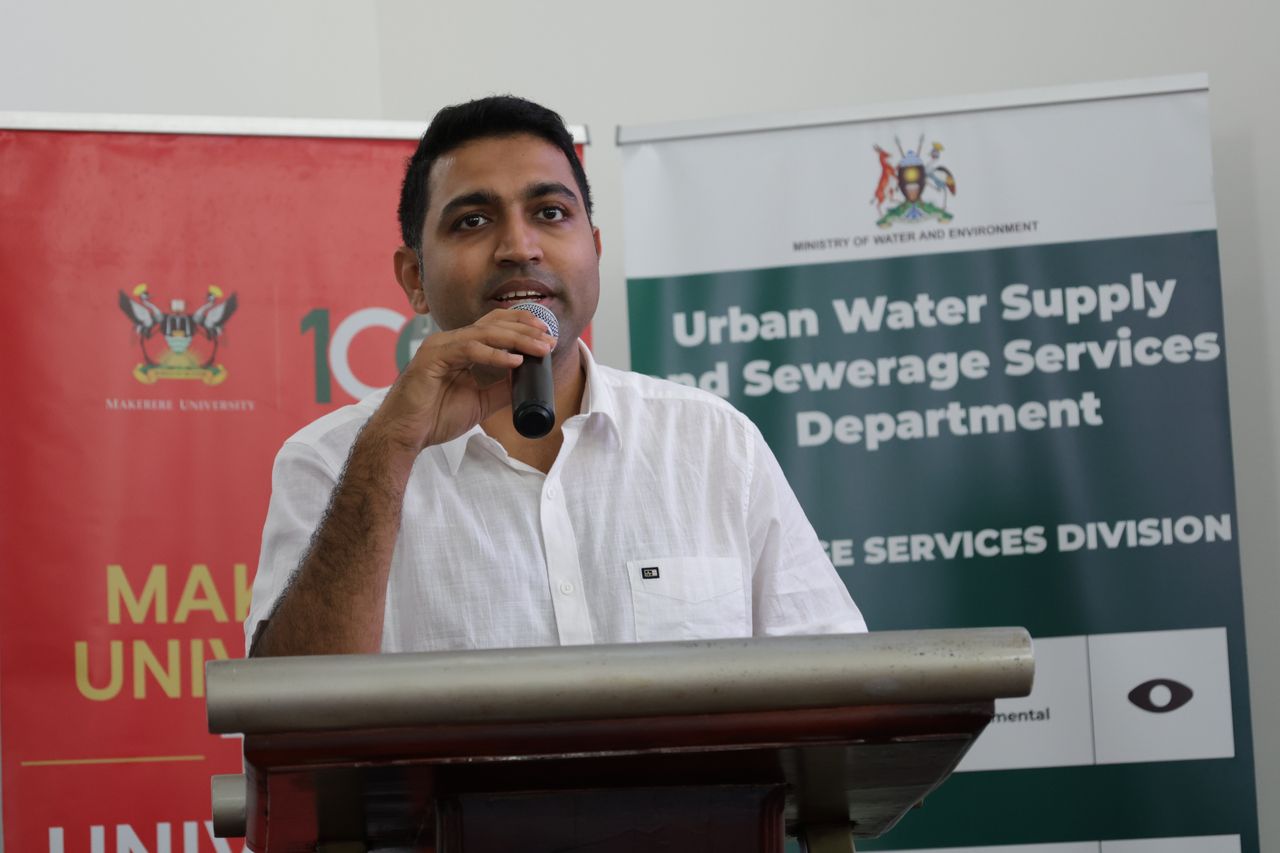
Written by Skye Erika Hasseriis, intern at the SuSanA Secretariat, based on an interview with Mr Narayan.
