

1. Let’s start with a quick introduction – who are you, and what’s your connection to the sanitation sector?
My name is Andrea Cáceres Almendrades. I was born in Mexico City, Mexico, raised in Lima, Peru, and I currently live in Madrid, Spain. I always like to share where I'm from because my migration and mobility story is deeply connected to the work I do today around water, sanitation, and climate resilience.
Since my teenage years, I have observed how access to water and sanitation differs dramatically across countries and communities. For me, becoming part of this field felt inevitable. I consider myself a water and sanitation advocate, but I am also a professional in International Development. My work now focuses on youth leadership, capacity strengthening, and community-rooted approaches. Today, I am the Founder and Executive Director of The AWA Project, a youth-led organization advancing equality by empowering young people to contribute to the water and sanitation sector.
2. When did you first think: "I want to make a difference in sanitation"?
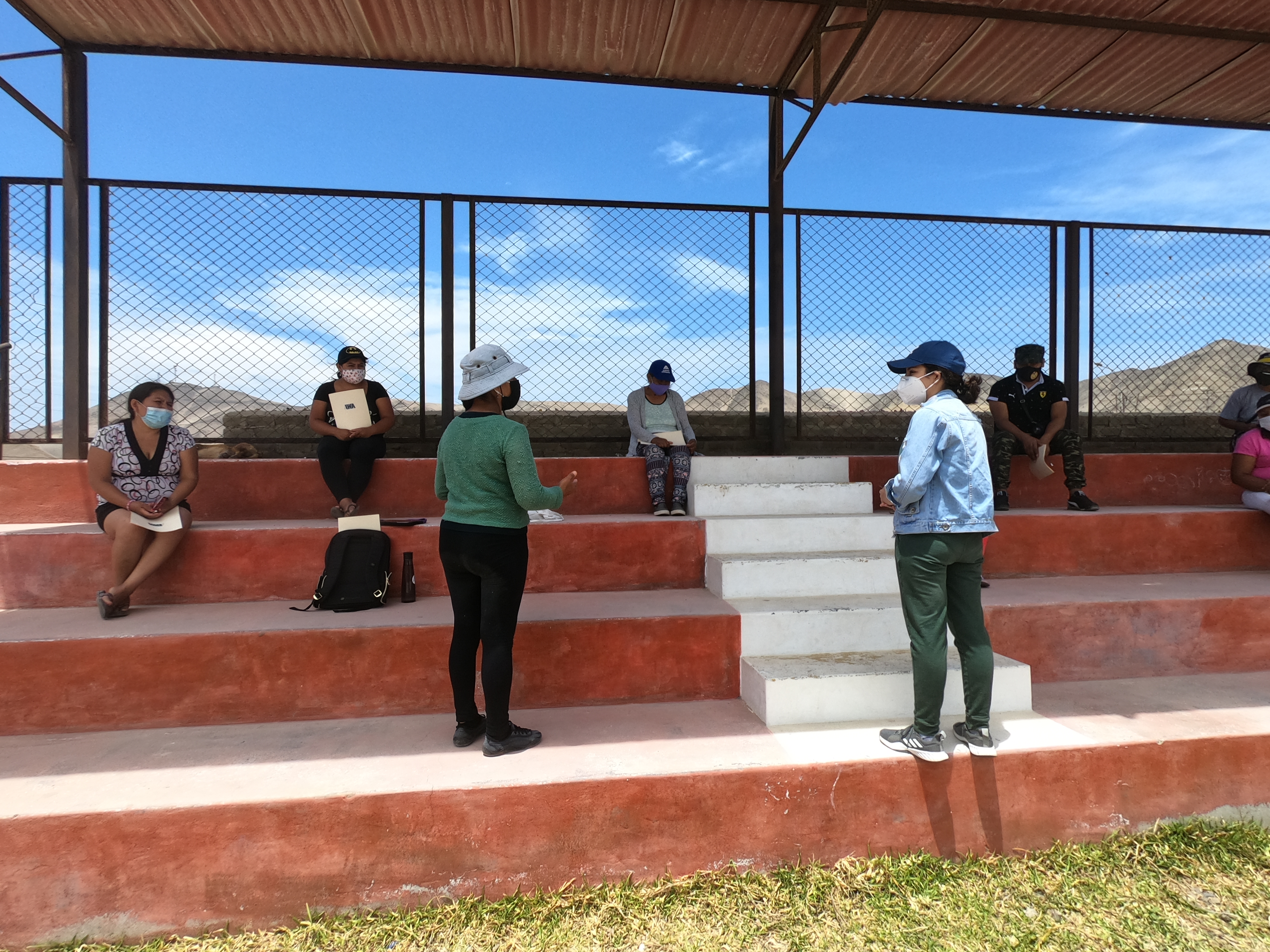
It was during the COVID-19 pandemic. I remember feeling anger and disbelief at how the world openly talked about sanitation as key to protecting ourselves without acknowledging that so many communities had no way to follow those recommendations. As I worked with a community in Peru, I saw families forced to choose daily how to use their limited water: for hygiene, agriculture, income-generating activities, or health.
What struck me was the injustice of this choice. “It was very horrific because there was an over-vigilance in these poor and vulnerable communities that didn’t have access to make these choices… they were even more marginalized from spaces because they couldn’t comply with what the world was asking us to do.”
Together with the community, we developed a fog-harvesting system as an additional water source. The idea was to create another source of water that the community could choose how to use, whether for agriculture or for household needs. And in these communities, cultural rituals around Mother Earth, also known as “Pachamama”, and people’s connection to water are so strong. Throughout this process, I came to understand just how interconnected sanitation is with water, culture, spirituality, and Indigenous knowledge.
3. What keeps you passionate and motivated to work in this sector?
It’s not always easy to stay motivated. The work can feel heavy, and the challenges are enormous. But what keeps me going are two things.
First, young people. “I’ve just found other young people who are as passionate or even more passionate than I am… and that is just the hope that we need today.” Their curiosity, even without resources, inspires me constantly.
Second, a grounding belief that this work is not about me. I often remind young people…and myself…that “this work is not about us… it is about water, it is about sanitation, it is about nature. It’s beyond us.” Understanding that I am part of something much bigger helps me stay committed, even though moments of doubt.
4. In your view, how can we break the taboo around toilets and sanitation – and why does that matter?
We must remember that sanitation is about dignity and human rights. “We all use toilets, we all wash our hands, we all need access to water.”
However, for some, talking about toilets might be uncomfortable, because taboos make us uncomfortable. My grandfather always taught me not to turn away from discomfort but to stay curious. “Whenever we encounter those taboos or feeling uncomfortable, just stay there for a minute… try to stay in that ambiguity and see how it feels.”
But breaking taboos is not simply about pushing conversations. We must first understand why these taboos exist. Many are shaped by histories of inequality and exclusion. If we replicate those same dynamics through top-down narratives, communities will understandably withdraw.
Breaking taboos also requires new storytelling. It means stepping away from technocratic language and instead making space for personal stories, lived experiences, and cultural perspectives. At the AWA Project, for example, our podcast doesn’t require “experts”. Anyone can share how water and sanitation shape their life. Those stories create connection, recognition, and openness.
5. What’s one widespread myth or misconception about sanitation you’d love to change?
One misconception I often see is the idea that only technical experts belong in the sanitation sector. As someone with a social sciences background, I’ve faced skepticism. Sometimes even from within the sector. “I have been questioned too many times on why I want to be a part of the sector… that’s not welcoming, especially for young people who are curious.”
Sanitation is not only engineering, infrastructure, or technology. It is culture, behavior, community, gender, justice, and human rights. We need diverse expertise to address such a multidimensional challenge. I want young people, especially young women and young professionals from non-technical fields, to know that they absolutely have a place here.
6. What would it take to get more people – especially young professionals – excited about sanitation work?
The sector needs a rebranding. It often feels old, technical, and uninviting, which creates friction for newcomers, especially those outside engineering fields. At World Water Week, I heard a statement that stayed with me: we need to position sanitation as a space for radical innovation.
Sanitation is a field where science, engineering, art, design, communication, culture, and activism intersect. Storytelling can become a powerful entry point for engagement. And we must speak in accessible, everyday language. Not jargon that alienates young people.
We also need generational exchange. Young people shouldn’t speak only to young people; experts shouldn’t speak only to experts. Innovation thrives when diverse experiences meet!
7. Looking ahead: What’s your hope for the sanitation sector in the next 10 years?
With 2030 approaching rapidly, I don’t believe we will achieve SDG 6- access to water and sanitation for all. But I do believe the coming years can be transformative if we treat this moment as a wake-up call.
“I hope to see a sector that is more inclusive and youth-driven… where marginalised communities are not an afterthought.”
We must integrate human rights, climate resilience, gender equality, and cultural perspectives into sanitation. Not as add-ons, but as essential pillars. And we need the courage to innovate radically, rethink old models, and embrace new voices.
8. Last, but not least: Can you describe your dream toilet or sanitation system?
My dream toilet is not a specific technology, it’s rather a philosophy. I see water as movement, as a meeting point through which communities connect. “In an ideal world, it would be great for water to just be a medium and not a source or a place of contamination.”
I imagine a system where wastewater treatment creates no harm, where nature-based solutions and circularity guide our designs, and where communities shape systems that reflect their cultural and environmental realities. It’s abstract, but sanitation itself demands imagination and radical ideas. As I often say, thinking outside the box is part of the work.